The Paradigm Shift in Medical Triage: How AI is Revolutionizing Emergency Care
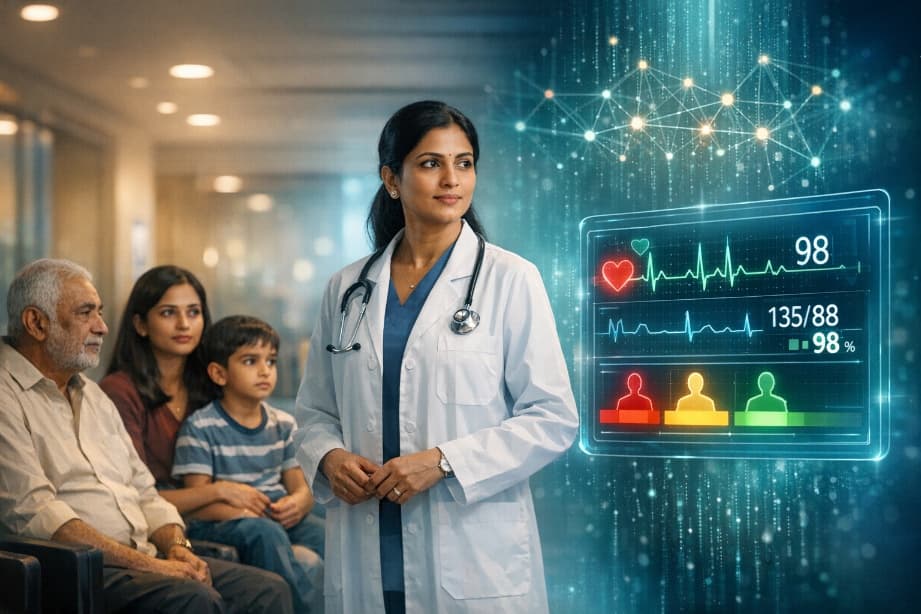
The global healthcare ecosystem faces unprecedented strain: surging patient volumes, escalating clinical complexity, severe workforce attrition, and systemic resource constraints. At the epicenter lies the emergency department (ED), where medical triage—the process of prioritizing treatments based on severity—has historically relied on subjective clinical judgment. But Artificial Intelligence is fundamentally redefining emergency care.
From Ambient Clinical Intelligence that documents patient encounters in real-time to humanoid robots conducting initial assessments, AI is transforming triage from an episodic, error-prone process into a continuous, data-driven precision operation. This article explores the technological architectures, clinical efficacy, and real-world implementations—particularly in India's high-pressure healthcare environment.
The Technological Architecture of AI-Driven Triage
Natural Language Processing and Ambient Clinical Intelligence
Natural Language Processing (NLP) serves as the critical bridge between unstructured human communication and structured computational analysis. In triage environments, NLP algorithms deploy semantic mapping to extract clinical entities, symptom clusters, and risk factors from patient narratives.
A profound manifestation is Ambient Clinical Intelligence (ACI)—real-time NLP combined with speech recognition that passively monitors clinician-patient interactions. Instead of physicians turning away to input data, ACI automatically captures and structures verbal dialogue into comprehensive medical documentation. Real-world implementations have compressed clinical documentation time from over two hours daily to merely fifteen minutes per patient. By eliminating clerical burden, ACI ensures cognitive bandwidth is allocated to empathetic patient assessment.
Conversational AI and Medical Chatbots
The proliferation of Large Language Models (LLMs) has catalyzed sophisticated conversational AI platforms. Unlike rigid decision-tree chatbots, modern healthcare virtual assistants synthesize LLMs with peer-reviewed medical knowledge graphs to conduct nuanced preliminary assessments.
Leading healthcare institutions have deployed AI chatbots at massive scale. One prominent academic medical center's system handles over 4 million patient interactions monthly, achieving an 87% "excellent" user satisfaction rating and a 23% improvement in diagnostic accuracy compared to traditional telephonic nurse triage. Modern healthcare chatbots have reduced aggregate patient wait times by up to 60%, reclaiming two to three hours daily for healthcare staff.
Predictive Analytics and Machine Learning
Beyond textual analysis, multimodal machine learning models synthesize diverse data streams to generate predictive acuity scores in real-time. These models incorporate:
- Prior healthcare utilization records
- Longitudinal medical histories
- Historical laboratory results
- Medication adherence patterns
- Detailed demographic variables
Research indicates ML models have recorded AUROC values exceeding 0.90 for predicting hospitalizations—vastly outperforming traditional triage systems. By cross-referencing real-time presentations with longitudinal histories, these engines enable proactive resource staging and ICU demand anticipation.
Embodied AI: Robotic Triage
The DAISY project (Diagnostic AI System for Robot-Assisted Triage) represents the frontier of embodied AI. This humanoid robot automates initial triage stages within ED waiting areas, providing voice-guided instructions for self-administered vital sign capture while utilizing conversational AI to elicit symptom histories. Feasibility studies are evaluating diagnostic concordance and patient acceptability of this robotic intermediation.
Clinical Efficacy: AI vs. Human Practitioners
The Human Interrater Reliability Challenge
Before benchmarking AI, consider the fragility of human "gold standards." Research evaluating 300 digital medical histories found interrater reliability among five expert physicians yielded Cohen's kappa of merely 0.20—indicating slight to fair agreement. Intrarater reliability (same physician re-evaluating cases later) yielded kappa of only 0.55. AI is frequently penalized for deviating from a human baseline that is itself highly variable.
Diagnostic Concordance
Comparative studies reveal compelling results. AI triage systems have achieved precision and recall parameters comparable to human general practitioners. Notably, human doctors exhibited an average recall rate of 83.9%—entirely omitting the correct diagnosis in approximately 16% of clinical vignettes. AI systems have provided triage recommendations deemed safer than human cohorts (90.0% vs. 89.2% safety rating).
ML models demonstrate superior discrimination abilities compared to conventional triage, reducing aggregate mis-triage rates by 0.3% to 8.9%. For Emergency Severity Index (ESI) level prediction, AI models have achieved robust F1-scores of 72.2%.
The Acuity Stratification Paradox
A 2024 study at King Saud Medical City evaluated ChatGPT-4.0 against CTAS across 138 patients. The AI demonstrated 85.61% agreement with frontline physicians (κ = 0.780)—but accuracy plummeted to 42.86% against senior consultants. This reveals that frontline residents rely on structured symptom clustering that mirrors LLM training data, while senior consultants utilize tacit knowledge defying rigid algorithmic categorization.
Importantly, the study identified a "safety-preserving bias"—systematic over-triaging to mathematically prevent missing critical illness. While this strains resources, it's generally preferred over under-triage, which can precipitate life-threatening delays for acute conditions.
Operational Optimization: The Apollo Hospitals Case Study
Continuous Triage and "Failure to Rescue"
Traditional triage is episodic—patients are assessed once, then queue. AI-powered continuous monitoring transforms triage into a dynamic process. Apollo Hospitals' "Enhanced Connected Care" system utilizes sensor sheets beneath patient beds to continuously capture vital signs without patient compliance requirements.
The integrated AI engine detects abnormal physiological trends hours before overt clinical deterioration. The outcomes are staggering: 80% reduction in 'Code Blue' emergency events, shifting care from reactive crisis resuscitation to proactive stabilization.
Workforce Augmentation and Economic Impact
The time nurses spent on manual vital recording was slashed from 3.5 hours to 1 hour per shift—a 70% reduction in clerical workload. Macroeconomic implications include:
- Hospital ward operational costs diminished by 26%
- Cost per CCU bed decreased by 14%
- Overall patient treatment costs fell by 18%
- Patient experience metrics surged from 47% to 89%
The Indian Crucible: AI Triage in Mumbai's Healthcare Network
Public Sector: BMC AI Health Chatbot
The Brihanmumbai Municipal Corporation (BMC) manages one of Asia's largest urban public health networks. To democratize triage, BMC launched an AI-powered health chatbot (9892993368) that interacts with citizens in multiple regional languages to triage symptoms, provide maternal health guidance, and facilitate OPD appointment registrations. This digital front door reduces physical crowding at hospital reception centers while bridging urban health literacy gaps.
Private Tertiary Centers: Specialized AI Deployments
Leading private hospital networks have deployed specialized AI diagnostic systems across cardiology, neurology, and oncology. In cardiology, AI systems analyze 20+ clinical and lifestyle indicators to triage cardiovascular risk in under a minute, enabling predictive stratification of asymptomatic high-risk patients.
In neurovascular care, AI-powered imaging analysis platforms have revolutionized stroke treatment. These systems analyze cerebrovascular imaging instantly, expanding the stroke treatment window from 6 hours to an unprecedented 24 hours through precise radiological triage.
Cancer care institutes are embedding AI-driven diagnostics including next-generation AI-powered MRI systems that automate positioning and reduce motion artifacts—enabling rapid, accurate full-body imaging for triaging severe trauma and oncology cases.
Ethical Vulnerabilities and the "Black Box" Dilemma
Automation Bias and Algorithmic Determinism
The "black box" nature of deep learning creates profound challenges. When neural networks process millions of data points to recommend triage tiers, the specific computational weights are opaque to human users. This breeds automation bias—time-pressured clinicians passively accepting algorithmic outputs without critical scrutiny, heightening misdiagnosis risk.
Algorithmic Inequity
AI systems trained on non-representative datasets codify and scale structural biases. If trained predominantly on affluent urban populations, accuracy degrades significantly for rural communities with different baseline comorbidities. This threatens to amplify existing healthcare disparities.
Privacy, Surveillance, and India's DPDP Act
Technologies like ACI that continuously record patient-provider interactions introduce severe privacy vulnerabilities. India's Digital Personal Data Protection (DPDP) Act of 2023 mandates explicit consent prior to health data collection—creating logistical challenges for high-stress ED environments.
Regulatory Frameworks: FDA, EMA, and CDSCO
| Regulatory Body | Key Framework | Core Philosophy |
|---|---|---|
| US FDA | 510(k) and PMA Pathways | Risk-based classification; strict "human-in-the-loop" mandate |
| EU EMA | EU AI Act (2025) | Categorizes healthcare AI as high-risk; demands training data transparency |
| India CDSCO | Draft Guidance on SaMD (Oct 2025) | Differentiates SaMD vs SiMD; lifecycle-oriented compliance |
India's CDSCO Draft Guidance on Medical Device Software (October 2025) explicitly aligns Indian digital health regulations with IMDRF global practices, distinguishing between Software in a Medical Device (SiMD) and Software as a Medical Device (SaMD).
The Liability Crisis and Medical Jurisprudence
Current legal frameworks inadequately address algorithmic failures. The classic Bolam test—that a doctor is not negligent if acting per accepted medical practice—disintegrates when human judgment synthesizes with opaque AI recommendations. Indian legislation lacks mechanisms to address automated decision-making, creating a profound legal vacuum that chills clinical adoption.
Does liability fall upon the software developer, hospital administration, or individual physician? Comprehensive AI healthcare liability legislation is urgently required to define boundaries of algorithmic autonomy and establish AI-specific error reporting frameworks.
Future Trajectories: Pre-Hospital and Agentic AI
Pre-Hospital Triage and Wearable Integration
The future lies outside hospital walls. AI systems increasingly interface with consumer wearables for real-time pre-hospital telemetry. Apollo Hospitals is developing 5G-connected ambulances with specialized AI-based triage engines for rural first responders—facilitating protocol-driven interventions before patients reach tertiary facilities.
The Shift Toward Agentic AI
While current models are reactive, Agentic AI systems can plan, reason, and autonomously execute complex, multi-step workflows. In advanced triage contexts, Agentic AI could analyze patient history, query regional databases, order preliminary investigations, and dynamically secure ICU beds prior to human physician assessment—all within strict safety guardrails.
Conclusion: A Cognitive Exoskeleton for Healthcare
The integration of AI into medical triage marks a definitive inflection point. By synthesizing massive data streams with unprecedented velocity, AI technologies—from Ambient Clinical Intelligence to embodied robotic assistants—are dismantling the subjective constraints of traditional emergency prioritization.
The evidence demonstrates that AI can vastly compress documentation times, reduce clerical workloads, and achieve predictive precision matching or exceeding human baselines. Healthcare networks across India and globally illustrate a systemic shift toward continuous, proactive monitoring that reduces critical emergencies and yields substantial economic optimizations.
However, algorithmic black boxes, over-triage biases, and codified demographic disparities demand transparent, Explainable AI architectures. The global regulatory apparatus is currently insufficient—overcoming the medicolegal liability vacuum requires adaptive frameworks that supersede outdated precedents.
Ultimately, AI in medical triage must not be viewed as a cost-cutting replacement for clinicians. Rather, it must be developed as an indispensable cognitive exoskeleton—offloading data synthesis and routine classification to computational systems, thereby reclaiming the finite resources of time and cognitive bandwidth for human practitioners to deliver complex, empathetic, definitive clinical care.
Ready to Experience AI-Powered Healthcare?
Join thousands of healthcare professionals and patients already using Sangya AI.
Get Started Free